Waco VA campus in Waco, Texas

Retire From Federal Service in Texas With a Clear Plan.


Knowing you’re eligible doesn’t tell you whether your retirement income will cover the life you want. Winnacle Wealth helps you bring your pension and savings into one retirement plan, with attention to taxes and the elections that affect your family.

Independent fiduciary financial planning in Waco, Texas. Talk Through Your Retirement

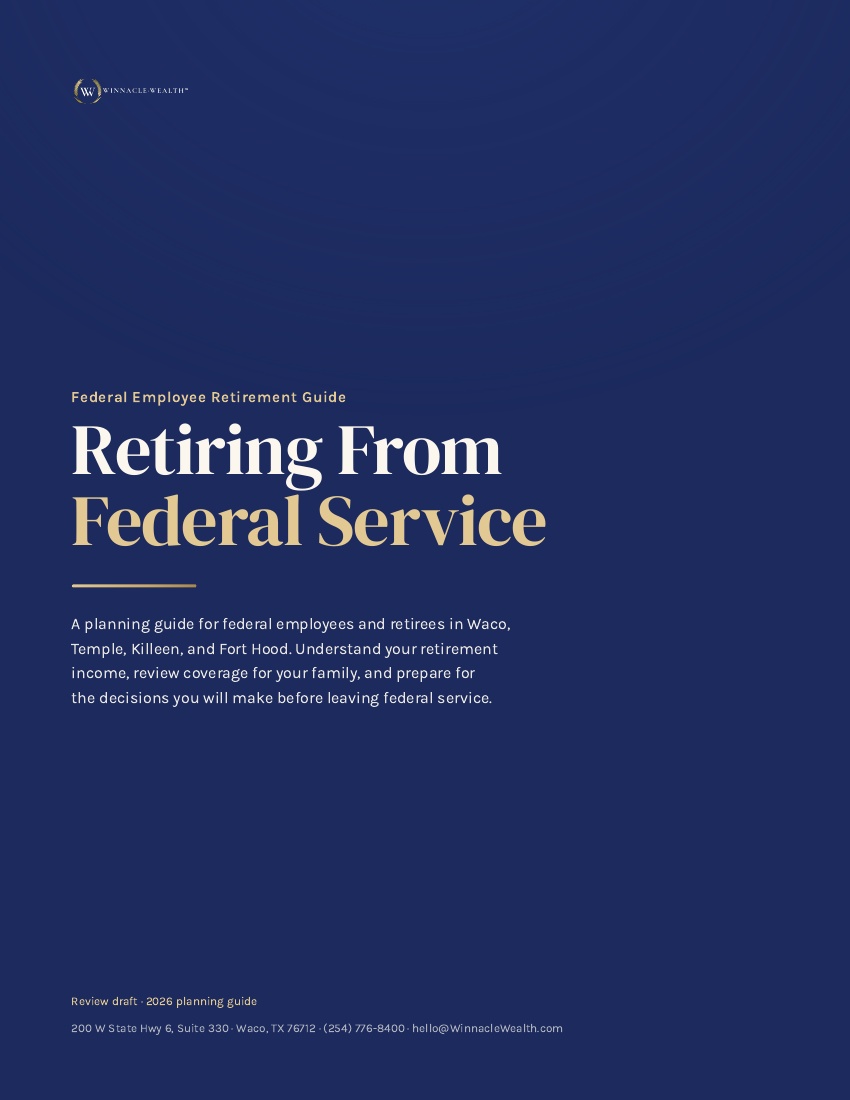
Cover of the guide Retiring From Federal Service

Retiring From Federal Service

Planning guide · updated for 2026

  • Compare retirement dates and income gaps
  • Health coverage and survivor decisions
  • Questions to take to HR and your advisor

Before You Choose Your Last Day.


You may feel ready to leave and still be unsure what you’ve overlooked. Review the decisions below before committing to a date.

1

Retiring Before Your Income Is Ready

Compare what your household spends with the income available when you leave. Your pension, any supplement and Social Security may start at different times, leaving periods you need to fund from savings.

2

Overlooking Taxes on Withdrawals

The amount you withdraw and the amount you have to spend can differ. Review traditional TSP withdrawals alongside your other taxable income before choosing how to pay yourself.

3

Assuming Health Coverage Continues

Pension eligibility doesn’t automatically preserve federal health coverage. Confirm your retirement route and coverage history with HR before counting on that insurance in your budget.

4

Choosing an Election Without Your Spouse’s Plan

A survivor election affects both today’s pension and what remains for your spouse. Look at the household’s other income and health coverage before making that choice.

Build Your Retirement Plan With Winnacle.


We start with what your household needs from retirement. Then we evaluate how your federal benefits fit with your other savings and your tax situation. Our One-Page Plan puts your priorities in view and identifies the next decision to address.

  1. Start With Your Life After Work

    We work through the spending your plan needs to support, including family commitments and the things you want more time for.

  2. Compare the Choices Available to You

    We compare your choices with attention to the income left after taxes. Your agency HR office and OPM confirm your official eligibility and benefit calculations.

  3. Put the Next Steps in Writing

    We identify what needs a decision now and what can wait. When a question needs your tax professional or HR office, we help you prepare for that conversation.

Meet Your Advisors

Chad Castle, RICP®, ChFC®

Chad Castle, RICP®, ChFC®

Co-founder. Serving families in financial services since 1995.

Jessica Burch, MBA, CFP®

Jessica Burch, MBA, CFP®

Co-founder. Helps clients with retirement planning, tax planning, and major life transitions.

FERS Retirement Calculator


Estimate an annuity for a simplified full-time civilian Federal Employees Retirement System (FERS) record using 2026 rules. Changing retirement age does not automatically add service or increase high-3; update those inputs separately.

Your inputs

Assumptions

Texas has no state income tax, so there are no state inputs. Federal income tax on the annuity and the TSP is not shown.

What the numbers show

Basic annuity per year$0
Per month, after the survivor election$0
Survivor annuity per year$0
Rough supplement, before earnings test$0

Enter your numbers to see the estimate.

This tool is educational and simplified. It estimates a pension for full-time civilian FERS service using 2026 rules. It does not cover every service history or retirement route, or account for taxes, insurance costs or court orders. The supplement uses your Social Security estimate and excludes reductions for earnings from work. Confirm your eligibility and official benefit amount with your agency or OPM. Results are simplified estimates, depend on assumptions entered by the user, and do not predict actual tax consequences. It is not tax or investment advice. Talk to your advisor and tax professional before making any election.

Your Federal Benefits at a Glance.


Use this overview as a reference while you review your retirement options. The guide covers the rules and questions in more detail.

FERS combines a basic annuity, Social Security, and the Thrift Savings Plan. A supplement may apply before 62. Eligibility and coverage depend on your service record and retirement route.

FERS basic annuity

For regular FERS, 1% of high-3 per year of creditable service, or 1.1% at separation at 62 or later with 20 years for computation. Unused sick leave adds computation credit, but cannot establish eligibility.

FERS annuity supplement

Available before 62 under qualifying retirement routes. OPM uses a constructed Social Security estimate and civilian FERS service. After MRA, an earnings test reduces it by $1 per $2 above $24,480 in 2026; MRA+10 retirees do not qualify.

Thrift Savings Plan

$24,500 in 2026, plus $8,000 at ages 50–59 or 64+, or $11,250 instead at ages 60–63. FERS agency contributions are an automatic 1% plus up to 4% matching. Contributing 5% each pay period earns the full match. If 2025 federal FICA wages topped $150,000, 2026 catch-ups must be Roth.

FEHB in retirement

FEHB generally requires immediate-retirement entitlement and five years of continuous coverage, including as a family member, or coverage since the first opportunity if shorter. Postal employees use PSHB, whose Medicare Part B requirement has exceptions.

Survivor election

A full survivor annuity pays 50% of the unreduced annuity and reduces your annuity by 10%; partial coverage pays 25% and costs 5%. A covered spouse generally needs survivor entitlement to continue your FEHB enrollment after your death.

VERA, VSIP, and reorganizations

FERS VERA can allow retirement at 50 with 20 years, or any age with 25, when your agency offers it and you qualify. The supplement waits until MRA. VSIP terms depend on agency authority; taxes are withheld from each payment.

Federal Retirement Questions.


How is my FERS pension calculated?

Regular FERS uses high-3 pay × computation service × 1%, or 1.1% if you separate at 62 or later with at least 20 computation years. Unused sick leave can count toward that computation threshold, but cannot establish retirement eligibility.

What is the FERS supplement, and when does it stop?

It provides income before 62 for qualifying retirees. OPM’s age-62 cutoff applies even if you delay Social Security. An earnings test can reduce payments after minimum retirement age (MRA). MRA+10 and deferred retirees do not qualify.

Can I keep my health insurance when I retire?

Generally, you need immediate-retirement entitlement and five continuous years of FEHB coverage (family coverage counts), or coverage since your first opportunity if shorter. If you postpone an MRA+10 annuity, coverage stops at separation and may resume when the annuity starts; a deferred annuity does not restore it. Postal employees follow separate PSHB rules.

What happens to my TSP when I retire?

You can leave at least $200 of vested funds in TSP or choose withdrawals, installments, a rollover of eligible distributions, or an annuity. The automatic 1% generally vests after three years of service, or two for certain positions. Compare taxes, withdrawal rules and fees before moving money. Traditional withdrawals are generally taxable; an annuity purchase is irreversible.

How Does the Survivor Election Affect My Spouse?

Electing less than full survivor coverage changes household income and requires your spouse’s consent before a notary or other authorized official. With no survivor annuity, your spouse cannot continue your FEHB enrollment after your death.

Does taking VERA change my pension?

Regular FERS uses the same formula without an age reduction, but the supplement waits until MRA. A CSRS component has separate rules. FEHB still requires qualifying coverage unless a waiver applies. VSIP is a separate payment with its own terms.

I'm CSRS. Did the Social Security Fairness Act change anything for me?

The law repealed WEP and GPO for benefits payable from January 2024. Other eligibility rules and benefit reductions still apply. Check your SSA record if you believe an adjustment is missing.

Where can federal employees in Texas get planning help?

Winnacle Wealth helps you evaluate how federal retirement benefits fit with household spending, savings and taxes. Your agency HR office handles official service records and retirement paperwork. Start with a Right Fit Call to discuss the help you’re looking for.

Cover of the guide Retiring From Federal Service

Retiring From Federal Service

Planning guide · updated for 2026

Get the guide ↑

Talk Through Your Retirement Before You File.


Bring the decision you’re weighing, whether it’s choosing a date or deciding how to use your savings. A Right Fit Call is a chance to discuss what you need and whether Winnacle’s approach fits.